

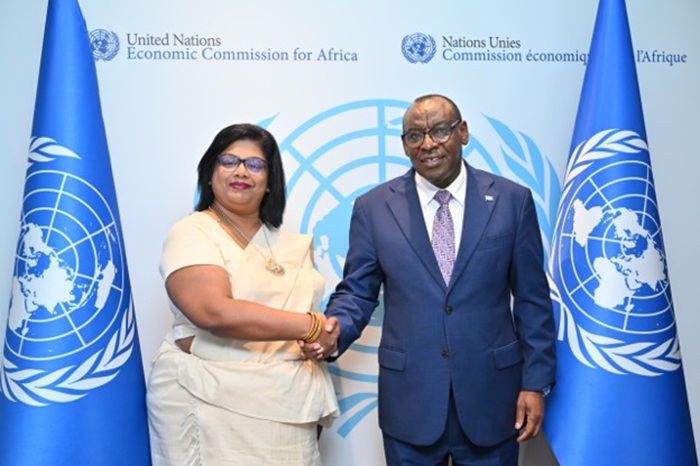
Sri Lanka’s first female Permanent Representative to the United Nations Economic Commission for Africa (UNECA), Nirmala Paranavitana, presented her credentials to Executive Secretary Claver Gatete, marking a new phase in Sri Lanka–Africa relations.
According to the Sri Lankan Embassy in Addis Ababa, Ethiopia, the appointment was hailed as a breakthrough for women’s leadership in Sri Lanka’s foreign service and a step towards building practical, inclusive partnerships with African nations.

Following the credential ceremony, Ambassador Paranavitana held wide‑ranging discussions with the Executive Secretary on strengthening South–South Cooperation, investment, technology transfer, private‑sector engagement, and knowledge exchange.
She outlined several initiatives under exploration with African partners: a rice knowledge‑exchange programme with Burundi in collaboration with the International Rice Research Institute (IRRI); cassava value addition and MSME development with the Central African Republic; power‑sector optimisation with Cameroon; textile and apparel value‑chain cooperation with Equatorial Guinea; digital skills and youth entrepreneurship in Chad and Ethiopia; and maritime security, fisheries, and Coast Guard capacity‑building with Somalia and Djibouti. Together, these projects could form the basis of a Sri Lanka–Horn of Africa economic and maritime cooperation strategy.
Further opportunities were discussed in Ethiopia, including dairy and milk processing, food manufacturing, and youth entrepreneurship linkages between Sri Lankan and Ethiopian innovators. In Chad, Sri Lanka is exploring the establishment of a Disaster Management Centre, drawing on its experience in tsunami response and flood preparedness.
Executive Secretary Gatete welcomed Sri Lanka’s proactive approach, identifying rice, cassava processing, mini‑hydropower, pharmaceuticals, and cotton‑to‑textile value chains as priority areas for collaboration.
He encouraged Sri Lanka to move beyond bilateral projects towards regional value chains that could serve larger African markets, noting Ethiopia’s potential as a foundation for piloting cooperation models.
UNECA expressed readiness to facilitate Sri Lanka’s engagement with African institutions and connect Sri Lankan expertise with identified development needs. Gatete also urged Sri Lankan companies to participate in UNECA and African Union platforms, including the Africa Business Forum, to expand trade and investment opportunities.
The Embassy added that the meeting underscored Sri Lanka’s intent to combine women’s leadership, economic diplomacy, and practical South–South Cooperation to build long‑term partnerships.
By leveraging its expertise in agriculture, disaster resilience, maritime security, and private‑sector innovation, Sri Lanka aims to contribute to Africa’s development priorities while opening new avenues for trade, investment, and employment.