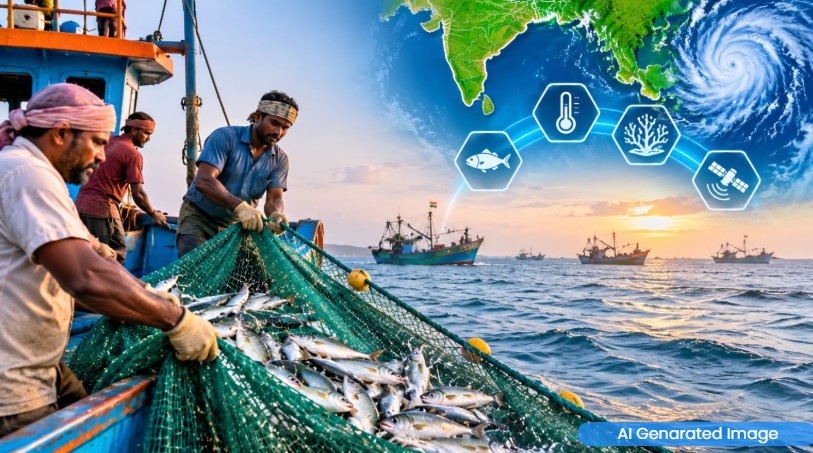
Four Bay of Bengal nations—India, Sri Lanka, Bangladesh, and the Maldives—have joined forces to launch the Bay of Bengal Network of Ocean Researchers for Fisheries (BOB-NOR), a regional research initiative aimed at strengthening climate-resilient fisheries management. Unveiled at the ICAR-Central Marine Fisheries Research Institute (CMFRI) on the sidelines of an international symposium, the network brings together ocean researchers, fisheries scientists, and international marine experts to integrate satellite observations, oceanographic surveys, climate indicators, and fisheries data. Coordinated by the Bay of Bengal Programme Inter-Governmental Organisation (BOBP-IGO) and supported by GEO Blue Planet, the Trevor Platt Science Foundation, and India’s Union Fisheries Department, BOB-NOR will study how changing sea temperatures, ocean currents, monsoon patterns, and salinity impact fish populations. By enabling predictive, data-driven advisories and evidence-based management beyond traditional catch assessments, the initiative aims to guide regional fishers and serve as a global model for sustainable marine resource management amidst changing ocean conditions.